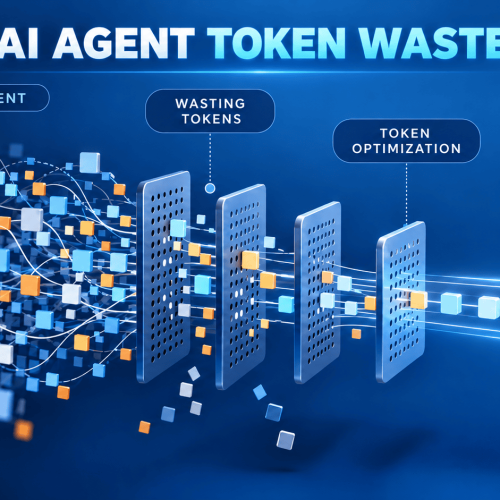
In this article, you will learn seven common token-waste patterns in production AI agent systems, and the architectural fixes that address each one.
Topics we will cover include:
- How treating the context window as a system of record inflates costs and latency, and how to fix it with sliding windows and semantic summarization.
- How uncompressed tool results, static schema bloat, and naive retrieval patterns silently drain your token budget.
- How to use circuit breakers, prompt prefixing, cascaded routing, and constrained output formats to build cost-stable agent architectures.

Introduction
Prototyping an agent over a weekend is one problem. Keeping its API bill from spiraling by month three is another. The naive approach to agent architecture — appending every user message, observation, and internal response to an endlessly growing array — quadratically increases inference latency and linearly inflates token costs on every call. The root of this failure is treating the context window as a system of record.
There’s a distinction many engineers miss early on: Context is the ephemeral token payload sent over the wire per request. State is the durable, serialized representation of the agent’s progress. Conflate the two and you’re paying for your database reads on every single inference call.
This tutorial covers seven of the most common and costly token-waste patterns in production agent systems, along with the architectural fixes that address each one.
1. Context Window Accumulation (The Append-Only Trap)
The most widespread mistake in agent design is treating the prompt array as a database. Every turn gets appended — user messages, tool observations, intermediate reasoning, assistant responses. By turn 20, the agent is re-reading its entire operational history on every request, paying quadratically increasing attention costs to do so.
The fix: Implement a sliding context window with semantic rolling summarization. Pass only the last N turns verbatim. Compress older conversational turns into a dense background summary, and offload structural agent state to a deterministic store like SQLite or Redis rather than injecting those values back into the prompt.
The catch: Summarization is inherently lossy. If an agent needs exact UUIDs, cryptographic hashes, or code snippets from early in a session, semantic compression will hallucinate them. Pair this pattern with a strict key-value lookup tool that retrieves exact strings when precision matters.
When to use it: This should be the default architecture for any long-lived conversational agent or iterative reasoning loop expected to exceed five to ten turns.
2. Uncompressed Tool Result Ingestion
When an agent calls a third-party API, it often receives a deeply nested JSON payload designed for machines, not language models. Dumping that raw response into the observation context is one of the most avoidable sources of token waste. A single Stripe webhook payload or verbose AWS API response can consume thousands of tokens, most of which contain nothing the agent will ever reason about.
The fix: Inject a middleware transformation layer between tool execution and context injection. This layer strips null values, filters non-essential keys, and reformats deep JSON into dense YAML or structured Markdown. For logs, a deterministic pre-processing pass can strip timestamps, thread IDs, and boilerplate before the model sees the data.
The catch: Aggressive filtering sometimes removes necessary metadata, like pagination cursors. If the agent needs to paginate through a list of results, stripping the next_token field to save a handful of tokens will silently break the entire retrieval loop.
When to use it: Whenever integrating third-party APIs — Stripe, Jira, AWS — that return verbose payloads optimized for machine consumption rather than language model reasoning.
3. Retrieval Thrash and “Grep-and-Dump”
In coding agents and RAG-heavy systems, a common pattern is using naive text matching to find relevant content, then dumping entire files into the context window. The agent needs a single function, so the orchestrator retrieves the entire 4,000-line file it lives in. It’s the retrieval equivalent of reading an entire encyclopedia to answer one question.
The fix: Shift to chunked, AST-aware (Abstract Syntax Tree) retrieval. During indexing, parse code into a live call graph. When the agent searches for a function, the orchestrator queries the index and returns only the exact function signature, its docstring, and immediate structural dependencies. That’s 300 tokens instead of an entire file. Libraries like Tree-sitter make it straightforward to build language-aware parsers that extract these structural units accurately.
The catch: Graph-aware retrieval requires continuous, asynchronous indexing pipelines. If the vector index lags behind the repository’s main branch, the agent will reason confidently about stale state, attempt to call functions that no longer exist, and burn output tokens working through the resulting errors.
When to use it: Building coding agents, RAG-heavy support bots, or any system interacting with rapidly mutating, highly structured codebases.
4. Static Tool Schema Bloat
Most agent frameworks define tool schemas once and inject all of them on every LLM call. For a small tool registry this is harmless. For an agent with 30 or 50 tools, the model is reading thousands of tokens of schema definitions on every request — including schemas for tools that are completely irrelevant to the current task phase.
The fix: Implement context-aware tool pruning governed by a finite state machine. The agent’s current operational state dictates which tools are injected. An agent in a “discovery” state receives only search and read tools. Once it transitions to “execution,” it receives only mutation and write tools. The irrelevant schemas never consume tokens.
The catch: Dynamic tool schemas interfere with prompt caching. Every time the tool subset array changes, the LLM provider must recompute the KV cache for the affected prompt prefix, resulting in higher latency and missed cache-hit discounts. This creates a direct tension with the advice in section six.
When to use it: Multi-agent architectures or solo agents with large tool registries where schema definitions alone exceed roughly 1,500 tokens of the context budget.
5. Unbounded Chain-of-Thought Loops
Autonomous agents can get stuck. A tool call fails, the agent retries, the retry fails for the same underlying reason, and the agent keeps generating reasoning and retry attempts indefinitely. Without hard limits, a single stuck task can consume tens of thousands of output tokens — which most providers bill at a higher rate than input tokens.
The fix: Implement an orchestrator-level circuit breaker. Enforce strict maximum retry counts on tool failures and cap the output token budget per action. When the agent hits the threshold, the orchestrator must intercept the loop, invoke a deterministic fallback, or escalate to a human in the loop rather than allowing further generation. Frameworks like LangChain and LlamaIndex offer built-in retry and callback hooks that can serve as the foundation for this kind of circuit breaker logic.
The catch: Circuit breakers can false-positive on genuinely complex tasks. A legitimate eight-step planning sequence requiring deep, multi-step search might trigger the limit right before the final synthesis step. Tuning retry thresholds requires observing real agent traces, not guessing in advance.
When to use it: This is a mandatory guardrail in any autonomous loop running in production. The cost of a false positive (a terminated task) is almost always lower than the cost of a runaway billing event.
6. Ignoring KV Cache and Prompt Prefixing
LLM providers cache the key-value representations of prompt prefixes to avoid recomputing attention over content they’ve already processed. This delivers meaningful latency reductions and, at providers that pass savings to users, real cost reductions. Most agents inadvertently defeat this by injecting dynamic variables (timestamps, user IDs, short-term memory snapshots) at the top of the prompt, before the static content.
The fix: Structure every request with a strict static-to-dynamic gradient. Place massive static content (system prompts, organizational style guides, persistent schema definitions) at the absolute top of the request. Never inject dynamic variables above the static payload. The cache boundary should fall at the end of the longest static prefix you can maintain. Both Anthropic’s prompt caching and OpenAI’s prompt caching documentation cover how to structure requests to maximize cache hits for their respective APIs.
The catch: Not all providers support KV caching, and those that do enforce TTLs — typically between five and fifteen minutes — that vary by provider. If the agent’s think-cycle is slow or the system is low-traffic, the cache will expire and you’ll pay full price for the prefix regardless of how carefully you structured the prompt. Keep in mind the tension this creates with section four: dynamically pruning tool schemas moves the cache boundary and reduces cache-hit rates.
When to use it: High-throughput, stateless agents where identical large system prompts are invoked thousands of times per hour. Below that scale, the cache-miss risk may outweigh the architectural overhead.
7. Monolithic Routing (Using Frontier Models for Simple Tasks)
Frontier models — Opus-tier or GPT-4-class — are priced at a significant premium over smaller alternatives. Using them to parse basic JSON, classify intents, or summarize simple application logs is the equivalent of hiring a senior architect to file paperwork. The task gets done, but the cost-to-output ratio falls apart at scale.
The fix: Implement a cascaded LLM router. Use a fast, small model — Haiku-tier or Gemini Flash-class — for intent classification, structural data extraction, and log summarization. Route to the frontier model only when complex multi-step reasoning is explicitly required by the classified intent. Open-source routing libraries like LiteLLM make it easier to implement provider-agnostic routing logic without rewriting API call scaffolding for each model.
The catch: Small models are brittle when confronted with complex or overlapping tool schemas. If the classification layer misroutes a request due to insufficient reasoning capacity, it will send garbage parameters to the frontier model, producing immediate failure and effectively doubling the token spend for that call. The routing boundary must be placed where the task complexity genuinely separates.
When to use it: Systems with predictable, high-volume inputs where structural sub-tasks can be cleanly decoupled from the core reasoning engine. If your inputs are highly variable or the intent boundary is ambiguous, cascaded routing introduces more failure surface than it saves.
Two Additional Patterns Worth Watching
The seven items above address the most common failure modes, but two patterns that don’t appear on many checklists are worth flagging.
Output token waste via unconstrained generation. The list above focuses primarily on input token waste, but output tokens are typically billed at a higher rate. When an agent is asked to extract structured data (a name and email, say) without a constrained output format, the model often generates conversational preamble before the actual values. Across thousands of calls, this adds up. Using provider-native structured output modes or tool-use schemas wherever the desired output is structured data rather than prose eliminates this category of waste entirely.
Redundant context injection. A surprisingly common production pattern is injecting the same information in multiple places: once in the system prompt, again as a reminder in a recent user-turn injection, and occasionally a third time as a tool result confirmation. Each copy costs tokens, and when one copy is updated while another isn’t, the agent must reconcile conflicting versions. An audit pass that treats each fact as having exactly one canonical injection point typically shaves 10-20% off total input tokens with no loss in task performance.
Conclusion
Token optimization isn’t about being cheap. It’s about system stability. A bloated context payload translates directly to higher inference latency and a larger surface area for retrieval failures and hallucinations. Constraining the context window to the minimum required for the task forces more deterministic behavior, reduces orchestrator timeouts, and tightens the system’s failure domain.
The patterns above aren’t mutually exclusive, and neither are their tradeoffs. Sections four and six pull in opposite directions: dynamic tool pruning saves tokens but undermines cache efficiency, while static prefixing maximizes cache hits but keeps irrelevant schemas in view. The right balance depends on the tool registry size, request volume, and the provider’s caching implementation. Real production traces are the only reliable way to find where to draw the line.
By day 100 in production, token waste stops being a billing issue and becomes a data quality issue. Stale facts accumulate in vector stores, episodic memory fills with outdated API documentation, and agents enter reasoning loops trying to reconcile hallucinated state with production reality. The architectural decisions made in week one compound in both directions.