

Google Gmail Offline Feature: Google’s Gmail remains one of the world’s most widely used email platforms, with over 1.8 billion users are using it for both professional and personal communication. Gmail also offers a range of features tailored for workplace and academic use. But what happens when you’re in a remote area with little or no internet access and need to send an urgent email? Until now, that would’ve been a major hurdle. Fortunately, Google has introduced a new Gmail’s handy offline feature that solves this problem. With this Gmail’s new feature, users can now access their Gmail account, read messages, respond to emails, access your inbox, compose new messages and even perform searches—all without an active internet connection. This enhancement is especially useful for those working or studying in low-connectivity zones. Here’s how you can enable and use Gmail offline feature in seconds How To Enable Offline Mail Step 1: Visit gmail.com using the Google Chrome browser (this feature doesn’t work on other browsers). Step 2: Click the gear icon in the top right corner, then select “See all settings.” Step 3: Click on the “Offline” tab from the settings menu. Step 4: Check the box that says “Enable offline mail.” Choose how many days of emails (up to 90 days) you want available offline. Step 5: Decide whether Gmail should keep or remove offline data when you log out. Finally, click “Save Changes.” How To Access Gmail Offline Step 1: Go to mail.google.com using the Chrome browser—even without an internet connection. Step 2: A message will appear confirming that you’re now in offline mode. Step 3: You can browse your inbox and read previously synced emails. Step 4: Create new emails that will be saved as drafts and automatically sent once you’re back online.
WhatsApp Blue Tick Verification Badge: How Android And iOS Users Can Apply; Check Eligibility, Cost | Technology News
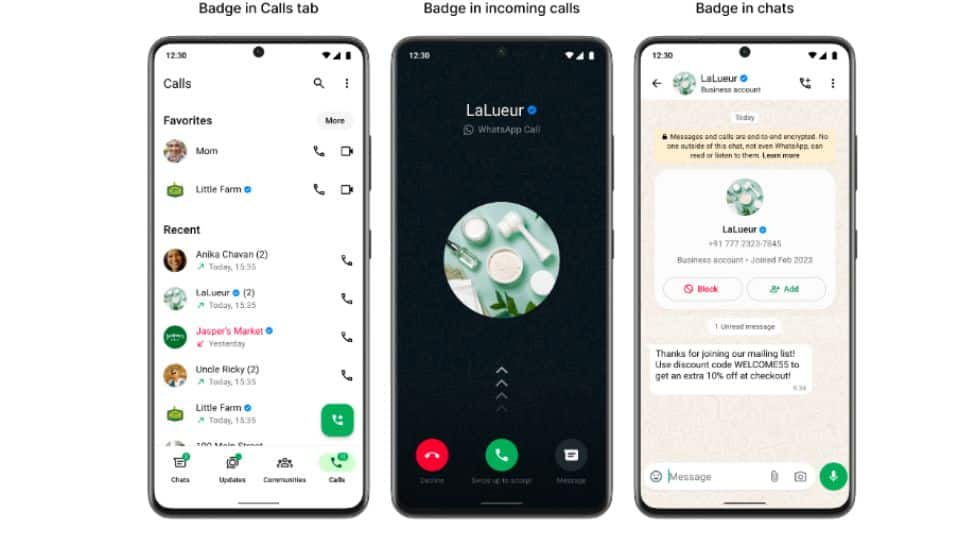
WhatsApp Blue Tick Verification Badge: Are you wondering how to get a blue tick on WhatsApp? Just like Instagram, Facebook, and X, WhatsApp also offers a verified blue tick—but it’s exclusive to business accounts. This badge appears as a blue mark next to the business name on WhatsApp. It helps users identify authentic businesses, building trust and credibility. If you run a business and want that mark of authenticity, there’s a clear process to follow through the WhatsApp Business app and a Meta Verified subscription. In this article, we will tell you which accounts are eligible, where the tick appears, and how to apply for the WhatsApp blue tick verification badge. Who Can Get WhatsApp Blue Tick Verification Badge? Before diving into the process of getting a blue tick on WhatsApp, it’s crucial to first understand who qualifies for it. The blue tick is available only for business accounts. This verified badge adds credibility to a business profile, giving customers greater confidence when interacting with the business on WhatsApp. It indicates that the account has been officially verified by Meta, based on its activity and the documents submitted for authentication. Meanwhile, Meta Verified is a paid monthly subscription that comes with several features such as a verified badge, account support, and account protection. Where Is Blue Tick Verified Badge Displayed? The Meta Verified badge, which appears as a sticker with a checkmark, helps users easily identify verified businesses on WhatsApp. Once a business is verified, this badge becomes visible in several places within the app, including the Calls tab, business profiles, context cards, chats, and during incoming calls from verified businesses. This consistent visibility reinforces the authenticity of the business across different touchpoints on WhatsApp. How Android and iOS Users Can Apply for the WhatsApp Blue Tick? Step 1: Open the WhatsApp Business app on your Android or iOS device. Step 2: Navigate to Settings. Tap the three dots at the top right and select Settings For Android users. Tap the Settings tab at the bottom right for iOS users. Step 3: Go to Tools in the Settings menu. Step 4: Tap on “Meta Verified” to access verification options. Step 5: Select a subscription package of your choice and complete the payment to get verified. WhatsApp Blue Tick Verification Badge Cost According to the Media reports, the cost of the blue tick ranges from Rs 639 to Rs 18,900, depending on the selected package, as WhatsApp Business offers multiple subscription plans for verification under the Meta Verified program.
Securing FastAPI Endpoints for MLOps: An Authentication Guide
In today’s AI world, data scientists are not just focused on training and optimizing machine learning models.
Madras HC Dismisses Xiaomi’s Petition Against ED Proceedings In FEMA Violation Case | Technology News
Chennai: The Madras High Court has dismissed the petitions filed by Xiaomi Technology India Pvt Ltd and its Chief Financial Officer Sameer B.S. Rao, seeking to quash the proceedings initiated by the Enforcement Directorate (ED) in connection with alleged violations under the Foreign Exchange Management Act (FEMA) involving royalty payments of Rs 5,551 crore. Justice N. Anand Venkatesh, delivering the verdict recently, held that the court would not interfere at the “formation of opinion” stage of proceedings under FEMA adjudication rules, as it was only a preliminary step and not a final determination of liability. Xiaomi India is engaged in the procurement, distribution, and sale of Xiaomi-branded products across India. In this context, the company entered into royalty agreements with Qualcomm Incorporated, Qualcomm Technologies Inc. (both US-based entities), and Beijing Xiaomi Mobile Software Co. Ltd, a group company based in China. According to the ED, Xiaomi remitted Rs 5,551 crore between 2016 and 2022 to these foreign entities as royalty payments, allegedly without obtaining prior approval from the Reserve Bank of India (RBI) — a requirement under FEMA for certain types of foreign remittances, especially where third-party transactions are involved. Following its investigation, the ED filed a complaint, and a show-cause notice was issued by the Adjudicating Authority under FEMA, which Xiaomi challenged before the High Court in April 2024. Appearing for Xiaomi, senior advocate K.G. Raghavan contended that the royalty payments were legitimate current account transactions and therefore did not require the RBI’s prior approval. He argued that the ED’s initiation of adjudication proceedings was unwarranted. However, Additional Solicitor General L. Sundaresan, representing the ED, submitted that the writ petition was premature, as the adjudication process was still at the stage of forming an opinion. He argued that this stage only requires prima facie material suggesting a contravention of FEMA provisions, and need not be based on conclusive findings. Sundaresan also cited a communication from Qualcomm, wherein Xiaomi was referred to as a “third party” remitting payments on behalf of foreign group entities — an act which, according to the ED, constitutes a violation under the FEMA. Accepting the ED’s submissions, the High Court held that interference at this stage was unwarranted and permitted the adjudication proceedings to continue. Consequently, Xiaomi’s plea challenging the show-cause notice and the formation of opinion was dismissed. “In the considered view of this Court, the case has now reached the stage under Rule 4(4) of the FEMA Rules, which is the stage of defence and therefore, the petitioners will be entitled to all the documents sought by them, including the non-RUDs,” the court said in its judgement delivered on June 26.
5 Advanced RAG Architectures Beyond Traditional Methods
Retrieval-augmented generation (RAG) has shaken up the world of language models by combining the best of two worlds: <a href="https://www.

How Lens Fungus Destroys Camera From Within – And What You Can Do About It | Gadgets News
New Delhi: A forgotten lens in a dark drawer. A whiff of humidity. That is all it takes. Days pass. Then weeks. Eventually, beneath the glass, something stirs. Threads. Webs. A delicate frost. And with it, the death of a lens begins. Lens fungus does not knock before entering. It finds the smallest crack in your routine, settles quietly inside the lens barrel and then feeds on oil, dust and even breath. Many photographers first notice it as a ghostly haze. Others, only when contrast fades, colors die and resale value drops like a stone. The real danger is not what you see. It is what you do not. These fungal spores are everywhere – in your home, your bag and your hands. They wait for moisture. Then they wake. And when they do, they do not only stay on one lens. They move by touch, by cloth and by carelessness. A full outbreak is only one bad habit away. Inside the lens, the damage begins quietly. Some fungi secrete acid. Coatings dissolve. Glass pits. The etching never heals. Even after a cleaning, the scars remain. Sharpness drops. The glow of backlight blooms where it should not. Every frame tells the story of a dying lens. Vintage lenses suffer more. They are old. Less sealed. Less defended. Yet modern lenses are not immune. A few weeks in a humid attic or sealed bag is all it takes. That is why pros open every lens once a month. They let them breathe. They let in light. They keep fungus afraid. Still, the myths linger. “It is just cosmetic.” “It is only on the edge.” But tests say otherwise. Once fungus crosses 20% of a lens surface, image degradation becomes measurable. Blacks go gray. Textures fade. Details vanish. Sometimes permanently. Fungus does not spread like a virus. But it thrives when photographers get lazy. One infected lens in a damp box can turn into five. Add neglect to the mix, and no dry box in the world can save you. The fix? Prevention. Use your lenses. Store them in dry cabinets. Let them see light. Keep them clean. Desiccant caps help. So does caution. If you see fungus, quarantine the lens. Treat it like a biohazard. Gloves. Flashlight. UV exposure. And if damage is deep, call a professional. Some fungi lie between glued elements. Some feed inside layers of optical cement. Once they reach that deep, DIY does not work. And repair costs often exceed the price of a new lens. Especially for zooms and rare glass. For beginners, one rule matters most – moisture kills optics. Always. If you are in the tropics, watch your humidity. Use silica. Use sealed boxes. Use common sense. Because the worst part of lens fungus is not what it destroys. It is when you realize the photos you missed because of it. The shot that went soft. The moment that never came back. Treat your gear like a living thing. It breathes. It decays. And if you ignore it long enough, it dies. Quietly. Silently. Just like fungus grows.

Samsung Galaxy S24 Ultra Gets Massive Discount On THIS Platform; Check Camera, Battery, And Other Specs | Technology News
Samsung Galaxy S24 Ultra Discount Offer: Planning to buy a new smartphone at a massive discount? This is the perfect time to upgrade your device without breaking the bank. Now, the Galaxy S24 Ultra has received a significant price cut on Amazon, making it more accessible to premium smartphone buyers. Originally priced much higher, the flagship device is now available for ₹83,990 after a 38% discount. The original price of the smartphone was Rs 1,34,999. The smartphone runs on One UI 6.1 based on Android 14. Samsung promises seven years of software updates and security patches. Consumers can purchase the smartphone in various colour options, including Titanium Gray, Titanium Black, Titanium Violet, and Titanium Yellow. Samsung Galaxy S24 Ultra Specifications The device features a stunning 6.8-inch Dynamic AMOLED 2X display with a smooth 120Hz refresh rate and sharp QHD+ resolution, offering an immersive visual experience. It is powered by the Snapdragon 8 Gen 3 for Galaxy chipset—an octa-core processor clocked at up to 3.39 GHz—ensuring top-tier performance. Users can choose from generous storage options of 256GB, 512GB, or 1TB to suit their needs. On the photography front, the phone stands out with a versatile quad-camera setup on the rear. It includes a 200MP main sensor, a 12MP ultrawide lens, a 50MP telephoto lens, and an additional 10MP telephoto sensor. For selfies and video calls, there is a 12MP front-facing camera. The phone is backed by a 5000mAh battery with fast charging support, the device keeps up with demanding usage. Connectivity is seamless, with support for 5G, Wi-Fi 6E, Bluetooth, NFC, and USB Type-C.

88% Global Firms Now Have Dedicated AI Budgets; Focus Shifts To Intelligent Agents: Report | Technology News
New Delhi: Nearly 88% of global enterprises now have dedicated budgets for Artificial Intelligence (AI), with nearly two-thirds of them spending over 15% of their overall tech budgets on AI projects, a new report said on Monday. This major investment push marks a clear shift from early experimentation with Generative AI to building intelligent, goal-oriented systems known as AI agents, according to data compiled by Nasscom. Titled ‘Enterprise Experiments with AI Agents – 2025 Global Trends,’ the report provides a comprehensive look at how companies across the globe are preparing for the next phase of AI adoption. Sangeeta Gupta, Senior Vice President and Chief Strategy Officer at Nasscom, said that enterprises are at a crucial turning point. “AI agents represent the next evolution of enterprise AI — one that requires philosophical shifts in how we view work, intelligence, and autonomy,” she said. However, she also emphasised that scaling AI systems responsibly would require strong trust, data readiness, and continuous human oversight. Based on responses from over 100 companies across 8–9 global regions and more than 10 industries, the study shows how enterprises are moving beyond passive data analysis to more active AI systems that can perform tasks and make decisions with human oversight. The report shows that businesses are strengthening their AI foundation through investments in GenAI tools, data infrastructure, and flexible processes. Many companies have already formed specialised AI teams and are working with advanced platforms, upgrading their tech setups to support the deployment of AI agents. However, despite high awareness of Generative AI, only half of the surveyed companies are fine-tuning large language models (LLMs) or foundation models for their own needs. One of the biggest highlights of the report is the growing interest in Agentic AI — systems designed to act independently while still being monitored by humans. About 62% of companies are experimenting with such AI agents, mainly for internal tasks such as IT operations, HR, and finance. External uses, like customer service, are still limited, with only 31% of enterprises using Agentic AI in those areas. However, looking ahead, 88% of companies plan to set aside budgets specifically for Agentic AI systems in 2025. The report also reveals that most companies are being cautious. Around 77% are designing Agentic AI systems with a ‘human-in-the-loop’ model to ensure oversight and adaptability. Only 46% are testing fully autonomous agents. Manufacturing companies appear to be ahead in adoption, using AI for robotics, quality control, and other operational areas. When it comes to benefits, companies believe AI agents can help in making faster decisions and responding better to market changes, the report said.
Nothing Phone 3 And Headphone 1 India Launch Tomorrow; Check Expected Specs, Price And Other Details | Technology News
Nothing Phone 3 India Launch: Nothing is set to launch its two highly anticipated products at a major event in London, United Kingdom on July 1 which is tomorrow. The company will unveil the Nothing Phone 3 and Nothing Headphone 1, an over-the-ear headphone. However, both devices have generated much attention among tech enthusiasts through leaks and rumours ahead of the official launch event. Notably, the device is coming nearly two years after the launch of the Nothing Phone 2 in the country. Adding further, the company promises a minimum of seven years of software support for the Phone (3), including five years of full Android updates and two years of security patches. The much-anticipated smartphone is expected to launch the latest Android 16 operating system. It is expected that the phone will have a dedicated AI button, similar to a feature on the iPhone (3a) series. Nothing Phone 3 Specifications (Expected) It is expected to feature the same 6.7-inch LTPO OLED display as its predecessor, offering vibrant visuals and adaptive refresh rates. Under the hood, it will likely be powered by Qualcomm’s upcoming Snapdragon 8s Gen 4 processor, paired with a 5,150mAh battery for extended usage. The phone is rumored to come in two configurations: one with 12GB RAM and 256GB storage, and another with 16GB RAM and 512GB storage. On the photography front, the smartphone may include a 50-megapixel main sensor and a 50-megapixel ultra-wide lens, while the front camera is expected to see a jump from 32 megapixels to 50 megapixels, enhancing selfie quality. Moreover, there could be an inclusion of eSIM support, offering users more flexibility in connectivity. Nothing Headphone 1 Specifications (Expected) It is designed to target the premium audio market, with performance reportedly set to surpass that of Apple’s AirPods Max. Weighing around 329 grams, these over-ear headphones are expected to feature custom 40mm drivers developed in collaboration with British audio company KEF, renowned for its high-quality speakers. The wearable device may offer up to 80 hours of playback without noise cancellation and around 35 hours with ANC enabled when using the AAC codec. For those using high-resolution LDAC streaming, users can expect up to 54 hours without ANC and 30 hours with it on. The headphones will also come loaded with smart features, including Google Fast Pair, Microsoft Swift Pair, dual-device connection, wear detection, low-latency gaming mode, LED charging indicators, personalised sound profiles, and support for Google’s “Find My Device” network. Nothing Phone 3 And Headphone 1 Price In India (Expected) The smartphone is expected to be competitively priced for the mid-range market in India, likely starting at around Rs 50,000 and going up to Rs 60,000. On the other hand, the Nothing Headphone 1 could be priced between Rs 15,000 and Rs 25,000, aiming to deliver premium features at a more accessible price point to the customers.

Govt Begins Testing New Mobile Alert System For Real-Time Disaster Warnings | Technology News
New Delhi: The Department of Telecommunications (DoT) on Monday announced that, in partnership with the National Disaster Management Authority (NDMA), it is currently testing a new mobile alert system that will help send emergency warnings to people across India in real time. This new system, known as the Cell Broadcast (CB) system, is designed to send alerts instantly to mobile phones in areas affected by natural disasters or emergencies like tsunamis, earthquakes, lightning, gas leaks, or chemical hazards. Unlike regular SMS alerts, which are sent individually, Cell Broadcast messages are sent to all mobile phones in a particular area at once, making them faster and more effective in critical situations. The CB system is being developed and implemented by the Centre for Development of Telematics (C-DOT), a leading R&D organisation under the Department of Telecom. The system is currently undergoing nationwide testing, which will last for about two to four weeks. During this time, people may receive test messages on their mobile phones in English and Hindi. These messages will clearly state that they are part of a test and do not require any action from the public. Only mobile phones with Cell Broadcast test channels enabled will receive these test messages. Also, some people might get the same message more than once, as the system is being tested across the entire mobile network, including all base stations and towers. The NDMA already runs an SMS-based alert system called ‘SACHET,’ which has been operational in all 36 states and Union Territories. Built using the Common Alerting Protocol recommended by the International Telecommunication Union (ITU), this system has already sent over 6,899 crore SMS alerts in more than 19 Indian languages during past disasters and extreme weather events. Once the testing of the Cell Broadcast system is complete, it will be used alongside SMS alerts to deliver warnings in real time and in multiple Indian languages to all mobile users — even if their phones do not have the test channels activated. The government has asked the public to cooperate during the testing phase and to ignore any test messages received. These messages are only meant to check the system’s performance and do not indicate any actual emergency.